
Choosing the right preschool for your child is one of the most important decisions you will make as a parent. At the heart of this decision often lies one key question: should you choose a Montessori or traditional preschool? Understanding Montessori vs traditional preschool differences helps parents make confident and informed choices that truly align with their child’s unique needs and learning style.
Both approaches have produced generations of successful, capable learners. However, they achieve this in fundamentally different ways. Montessori education emphasises child-led discovery, independence, and hands-on learning, while traditional preschools follow structured, teacher-directed instruction with age-grouped classrooms and standardised curricula.
At COZO preschool Malaysia, we believe Malaysian parents deserve a clear and honest comparison. This guide breaks down the core differences across curriculum, teaching style, environment, and long-term outcomes so you can choose the right fit for your child’s future success.
What Is Montessori Education?
Dr Maria Montessori, an Italian physician and educator, developed the Montessori method over 100 years ago. Today, it remains one of the world’s most respected early childhood education approaches. Moreover, its popularity among Malaysian parents continues to grow steadily as more families seek child-centred alternatives to conventional schooling.
Core Principles of Montessori
- Child-led learning: Children choose their own activities from a prepared selection of materials.
- Intrinsic motivation: Learning flows from curiosity and genuine interest rather than rewards or grades.
- Multi-age classrooms: Children aged three to six learn together, fostering natural mentorship and social growth.
- Hands-on materials: Specially designed Montessori materials invite children to explore concepts physically.
- Uninterrupted work cycles: Long blocks of focused time allow children to develop deep concentration and mastery.
The Prepared Environment
A hallmark of Montessori is its carefully designed classroom, often called the prepared environment. Specifically, every material, shelf, and space sits in a purposeful arrangement that invites exploration and builds independence. Furthermore, it supports development across five key areas: practical life, sensorial, language, mathematics, and culture.
The Role of the Montessori Teacher
Traditional preschool, sometimes called conventional or teacher-directed preschool, follows a structured and curriculum-driven model. Indeed, parents across Malaysia will recognise this approach immediately, as it closely mirrors the schooling they experienced themselves.
Core Features of Traditional Preschool
- Teacher-led instruction: The teacher directs activities, sets the pace, and delivers lessons to the whole class.
- Same-age classrooms: All children in the class share roughly the same age and developmental stage.
- Structured timetable: Each day follows a fixed schedule with set times for every subject or activity.
- Standardised curriculum: All children work through the same learning plan at the same pace.
- Assessment through tasks and worksheets: Teachers track progress via activities, colouring sheets, and direct observation.
Familiarity, Structure, and National Curriculum Alignment
Parents feel drawn to traditional preschools because the model looks and feels familiar, with circle time, phonics, counting, arts and crafts, and outdoor play all within a predictable daily routine. In addition, traditional preschools in Malaysia often align closely with the national preschool curriculum set by the Ministry of Education. Consequently, this alignment reassures parents who want clear evidence that their child will enter Year 1 well-prepared and confident.
Key Differences Between Montessori and Traditional Preschool
Now that we understand both models, here is a direct comparison across the areas that matter most to Malaysian families.
1. Learning Style: Child-Led vs Teacher-Led
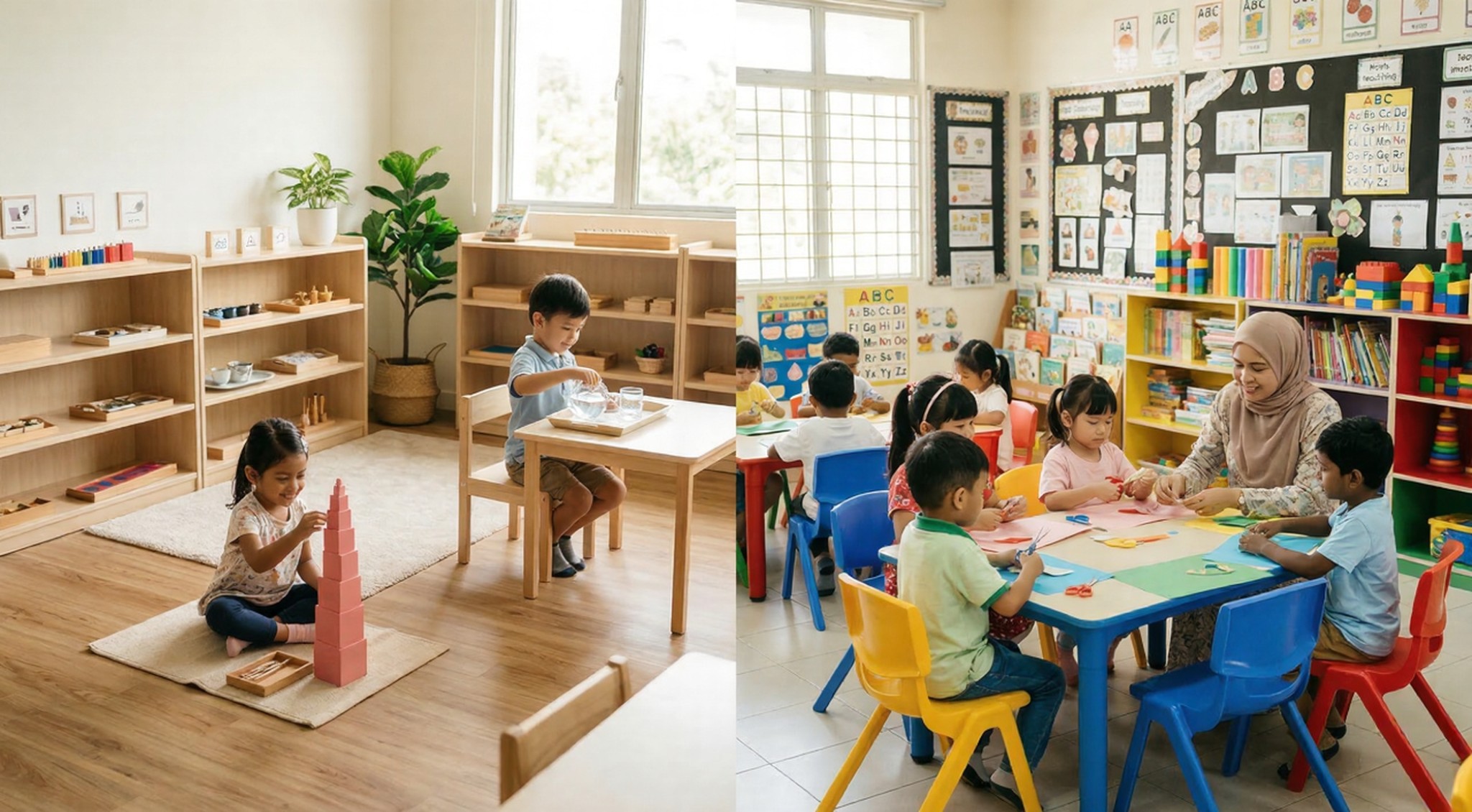
In Montessori, children actively choose their work based on interest and personal readiness. In contrast, traditional preschool gives the teacher full control over what the whole class learns and when. Neither model is inherently superior. However, children with strong independent streaks often thrive in Montessori, while those who prefer clear guidance generally do well in both settings.
2. Classroom Environment
Montessori classrooms feature low, open shelves where children access materials at all times. Traditional classrooms typically place the teacher at the front while children sit at tables or desks. Montessori environments stay intentionally calm and orderly, whereas traditional classrooms often use colourful displays and themed decorations to create a more visually stimulating space.
3. Assessment and Progress Tracking
Traditional preschools commonly track learning through worksheets, colouring tasks, and group activities. Montessori teachers, on the other hand, assess progress through close and ongoing observation rather than formal tests or paperwork. Importantly, both methods monitor development effectively, though the tools each approach uses look very different in practice.
4. Socialisation
Montessori’s mixed-age groupings create rich, natural mentoring opportunities. Specifically, older children reinforce their own learning by supporting younger classmates, while younger children gain inspiration from watching their older peers. By comparison, traditional same-age classrooms develop social skills primarily through group play and peer interaction among children at similar developmental stages.
5. Pace of Learning
One of the clearest strengths of Montessori is its respect for individual pace. For instance, a child fascinated by numbers can spend hours exploring mathematics, while another deepens language skills at the same time. Traditional preschools, by contrast, move the entire class through the curriculum together. This works well for children who thrive with a shared pace, but it may not suit those who need more time or are ready to move ahead quickly.
Benefits and Limitations of Each Approach
Montessori Preschool: Benefits
- Nurtures intrinsic motivation and a genuine love of learning
- Builds strong executive function, independence, and self-regulation
- Encourages deep focus and mastery through uninterrupted work cycles
- Develops natural leadership through mixed-age peer interactions
- Prepares children for lifelong learning, not just immediate school readiness
Montessori Preschool: Limitations
- The less structured approach can feel uncertain for parents accustomed to traditional models
- Some children need an adjustment period when transitioning into conventional primary school
- Schools need highly trained teachers to implement the method effectively
- Fees tend to be higher because of specialised materials and advanced teacher training
Traditional Preschool: Benefits
- A familiar structure makes the move to primary school smoother for many children
- Clear and measurable curriculum milestones give parents reassurance and peace of mind
- Children develop social skills naturally through group instruction and peer learning
- Predictable routines provide comfort and security for children who value consistency
- Generally more affordable and widely available across Malaysia
Traditional Preschool: Limitations
- Less flexibility to accommodate different learning paces and individual styles
- Can encourage passive reception of information rather than active discovery
- Children at different readiness levels may feel unchallenged or struggle to keep up
- External praise rather than internal curiosity tends to drive motivation in these settings
Which Approach Is Right for Your Child?
There is no single universal answer to the Montessori vs traditional preschool question. The best choice depends on your child’s personality, your family’s values, and the quality of the individual school you visit.
Consider Montessori If Your Child
- Shows natural curiosity and self-direction in play and everyday activities
- Prefers to explore topics at their own pace without being hurried
- Becomes deeply absorbed in activities that capture their imagination
- Sometimes struggles with rigid routines or highly prescriptive instructions
- Learns best through hands-on, physical, and sensory experiences
Consider Traditional Preschool If Your Child
- Enjoys predictable routines and clearly structured days
- Responds well to direct teacher instruction and defined expectations
- Loves group learning activities and thrives in social settings
- Gains confidence from step-by-step guidance and clear milestones
- Enjoys variety and welcomes frequent changes of activity throughout the day
Consider a Balanced Approach
Many of the best preschools in Malaysia today blend elements from both models. Our COZO Montessori programme combines authentic Montessori principles with the structured preparation Malaysian children need for primary school success. As a result, families gain the best of both approaches under one roof, supporting a wide range of learning styles while preserving the routine that young children genuinely benefit from.
Montessori vs Traditional Preschool in the Malaysian Context
National Curriculum Alignment
Many Malaysian parents wonder whether Montessori-educated children will cope well in national primary school. The answer is a clear yes. In fact, Montessori graduates often adapt to Year 1 more quickly than their peers because strong executive function, genuine enthusiasm for learning, and self-regulation give them exactly the tools the transition demands.
Language Development in Malaysia
Malaysia’s multilingual environment asks children to grow up with Bahasa Malaysia, English, and often Mandarin or Tamil alongside one another. Fortunately, Montessori’s rich, language-immersive approach supports simultaneous development across multiple languages very effectively. Similarly, quality traditional preschools prioritise language, so parents should look for programmes that build strong foundations in every language their child will need.
Quality Over Label
Ultimately, the label a preschool carries matters far less than the quality of its teachers, the warmth of its environment, and the care it shows each individual child. For example, a well-run traditional programme will always produce strong outcomes, just as a genuinely excellent Montessori school will. Therefore, parents should visit campuses, observe classrooms, and trust what they see rather than relying on a name alone.
Conclusion
Both Montessori and traditional preschool offer real and meaningful benefits. The right choice in the Montessori vs traditional preschool debate ultimately depends on your child’s personality and your family’s priorities. Above all, the goal is to find a high-quality programme where your child feels safe, genuinely challenged, and inspired to learn each day.
Curious to see COZO Montessori in action? Visit our campus today in Cheras or Bukit Jalil to experience our blended approach firsthand. Our qualified teachers and nurturing environments give every child the best possible start — come and discover which programme is the right fit for your family.
