
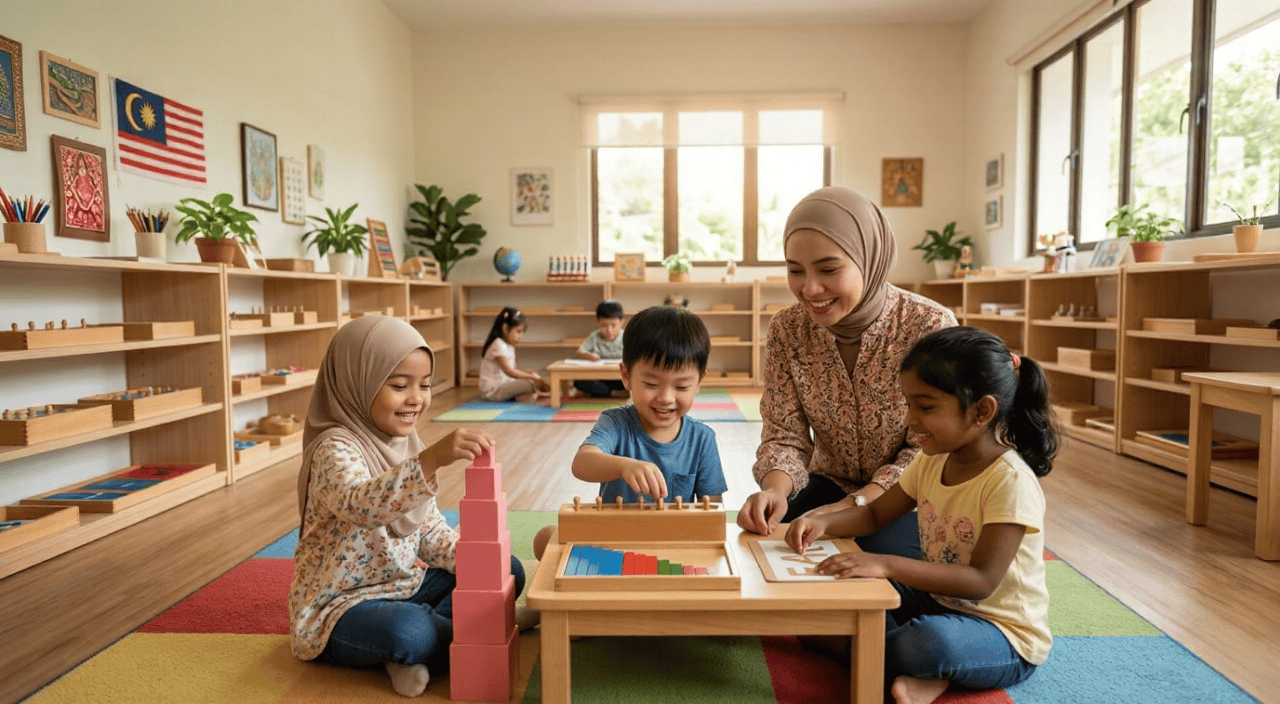
One of the most common questions parents ask when considering a Montessori preschool Malaysia is what their child will actually do each day. The answer goes far beyond what most people imagine when they picture early childhood education. Montessori activities preschool programmes deliver are not worksheets, rote drills, or teacher-led lessons delivered to a passive group.
Instead, they are carefully designed, hands-on experiences that engage a child’s natural curiosity, build genuine competence, and develop the independence and love of learning that last a lifetime. Each activity in a Montessori classroom serves a specific developmental purpose and fits within one of five curriculum areas that together address the whole child.
Understanding what these activities look like in practice and why they work so effectively helps parents make confident decisions about whether a Montessori preschool is the right environment for their child. This guide walks through the five core areas of Montessori activities preschool programmes deliver and explains what children actually gain from each one.
Practical Life: Building Independence and Concentration
Practical life activities form the foundation of every Montessori preschool classroom and are often the first area children encounter when they join. These activities mirror the real tasks of daily adult life and include pouring, spooning, sweeping, buttoning, folding, food preparation, and care of the classroom environment.
More Than It Appears
At first glance, these tasks may seem too simple to qualify as education. In reality, they are among the most developmentally rich activities a young child can engage with. Practical life work develops fine motor control with extraordinary precision, since the act of pouring water from a small jug into a cup without spilling requires the child to coordinate eye, hand, and muscle control in ways that build the exact skills needed for writing.
Concentration and Self-Confidence
Concentration deepens through practical life activities because each task has a clear beginning, middle, and end. Children who complete a practical life cycle independently develop the ability to sustain focused attention across a task, which is one of the most critical skills for primary school success. Independence and self-confidence grow as children master real and meaningful tasks, since a four-year-old who can prepare their own snack, clean up after themselves, and care for their classroom environment develops a genuine sense of capability that no amount of adult praise can manufacture.
Foundation for Later Learning
Practical life activities build the orderly thinking patterns and sequential reasoning that underpin mathematics and language learning later in the curriculum. Far from being a warm-up to the real education, practical life is the root from which all other Montessori learning grows.
Sensorial Activities: Refining the Senses and Building Concepts
Sensorial activities form the second major area of Montessori activities for preschool and address a fundamental truth about how young children learn. Between the ages of three and six, children exist in what Montessori called the sensitive period for sensory refinement, a window during which the brain is particularly receptive to organising and classifying sensory information.
Key Sensorial Materials
- Pink Tower: Develops dimension perception through ten cubes varying in size from one centimetre to ten centimetres.
- Colour Tablets: Refine visual discrimination across multiple shades of every primary and secondary colour.
- Sound Cylinders: Develop auditory discrimination by asking children to match pairs of cylinders by the sound they produce when shaken.
Building Mathematical and Linguistic Foundations
Beyond refining the senses themselves, sensorial work lays the mathematical and linguistic foundations that the child will build on explicitly in later curriculum areas. The concepts of order, gradation, and classification that children absorb through sensorial materials become the conceptual framework for understanding number, quantity, and pattern in mathematics. Furthermore, the rich vocabulary that Montessori teachers introduce alongside sensorial activities expands children’s language dramatically, since words like rough, smooth, loud, soft, identical, and similar enter a child’s working vocabulary through concrete sensorial experience rather than abstract definition.
Language Activities: Building Literacy From the Ground Up
Language development sits at the heart of Montessori activities preschool programmes and reflects one of Montessori’s most important insights about how children acquire literacy. Rather than teaching letters as abstract symbols, Montessori begins with the sounds that letters represent and builds outward from there.
Sandpaper Letters and the Movable Alphabet
Sandpaper Letters introduce each letter sound through simultaneous visual, auditory, and tactile experience. Children trace the letter shape with their fingers while hearing and saying the sound, engaging three learning pathways at once and producing far stronger retention than visual memorisation alone. The Movable Alphabet then allows children to compose words and sentences physically before their hands have developed the fine motor control needed for writing, since this separation of composition from the physical act of writing allows children to experience the joy of written communication long before handwriting becomes fluent.
Writing, Reading, and Comprehension
Metal Insets develop pencil control and hand strength through an engaging and purposeful activity rather than repetitive tracing exercises. Phonetic object boxes, classified picture cards, and command cards develop reading comprehension and vocabulary in progressive stages. All of these language activities connect to the child’s real experience and genuine communication rather than treating literacy as an isolated academic skill. Children in quality Montessori preschool environments consistently develop strong phonological awareness, early reading fluency, and a genuine love of books and storytelling.
Mathematics Activities: Making the Abstract Concrete
Montessori mathematics activities represent perhaps the most distinctive feature of Montessori activities for preschool and the one that most surprises parents who visit for the first time. Young children in Montessori classrooms work with concrete materials that make abstract mathematical concepts physically tangible before any symbolic representation is introduced.
Number, Quantity, and the Decimal System
- Number Rods: Introduce quantity and order through rods increasing in length from one to ten units, allowing children to count, order, and compare physically.
- Spindle Boxes: Introduce the concept of zero alongside quantities one to nine using real spindles children count and place into labelled compartments.
- Golden Bead Material: Introduces the decimal system through physical beads representing units, tens, hundreds, and thousands in concrete form.
Operations and Mathematical Confidence
Children who build thousands with their hands before encountering the abstract numeral 1,000 develop a genuine and intuitive understanding of place value that peers taught through symbols alone consistently struggle to match. Operations including addition, subtraction, multiplication, and division are all introduced through concrete materials before any abstract recording begins. As a result, Montessori-educated children approach mathematics with confidence and curiosity rather than anxiety, because every concept they encounter in written form already exists as a lived physical experience in their minds.
Cultural Activities: Nurturing Wonder About the World
The cultural curriculum area encompasses science, geography, history, botany, zoology, art, and music and reflects Montessori’s conviction that young children have a natural and powerful drive to understand the world they inhabit.
Geography, Science, and Nature
Geography activities include puzzle maps of continents and countries, land and water form trays, and globe work that gives children a concrete and tactile sense of the planet’s physical features. Botany and zoology activities develop scientific observation skills through direct engagement with plants, animals, and specimens, giving children both scientific vocabulary and the habit of careful, attentive observation.
History, Art, and Music
History activities introduce children to the concept of time through personal timelines and family history that connect abstract chronology to the child’s own lived experience. Art and music in the Montessori cultural curriculum develop creative expression and aesthetic appreciation using real art materials and genuine musical instruments rather than simplified toy versions. Across all cultural activities, the aim is to nurture what Montessori called cosmic education, a deep sense of wonder, interconnection, and responsibility toward the world that grows stronger with every passing year.
Montessori Activities at COZO: See It in Action
At COZO Montessori preschool, our Montessori activities reflect everything described in this guide and are delivered by formally qualified Montessori teachers who understand how to observe each child carefully and introduce activities at precisely the right developmental moment.
Authentic Materials, Qualified Teachers
Our classrooms stock authentic Montessori materials across all five curriculum areas, from the Pink Tower and Sandpaper Letters to the Golden Bead Material and cultural puzzle maps. Every teacher at COZO holds formal Montessori qualifications rather than simply following a Montessori-inspired programme, and this distinction matters enormously for the quality and consistency of what your child experiences each day.
Full Curriculum, Full Day
Children at COZO work at their own pace within a carefully prepared environment that challenges without overwhelming and supports without directing. Every day brings new discoveries across practical life, sensorial refinement, language, mathematics, and cultural exploration, woven together within uninterrupted morning work cycles that give children the deep concentration time that genuine Montessori learning requires.
Our Programme and Campuses
Our programme operates across our Cheras and Bukit Jalil campuses and delivers full English medium Montessori instruction alongside dedicated daily time for Bahasa Malaysia and Mandarin. Every family curious about Montessori activities for preschool is warmly invited to visit our campus, observe a morning work cycle, and see firsthand how our children engage with genuine Montessori learning every day.
Conclusion
Montessori activities preschool programmes deliver far more than early academic preparation. Across five deeply interconnected curriculum areas, they develop the whole child, building independence, concentration, language, mathematical thinking, and a genuine sense of wonder about the world. The results are children who enter primary school not just academically ready but genuinely motivated, confident, and equipped to keep growing.
At COZO, we bring this vision to life every day across our Cheras and Bukit Jalil campuses. Arrange a campus visit and see exactly what your child will learn, discover, and become in our authentic Montessori environment.
