
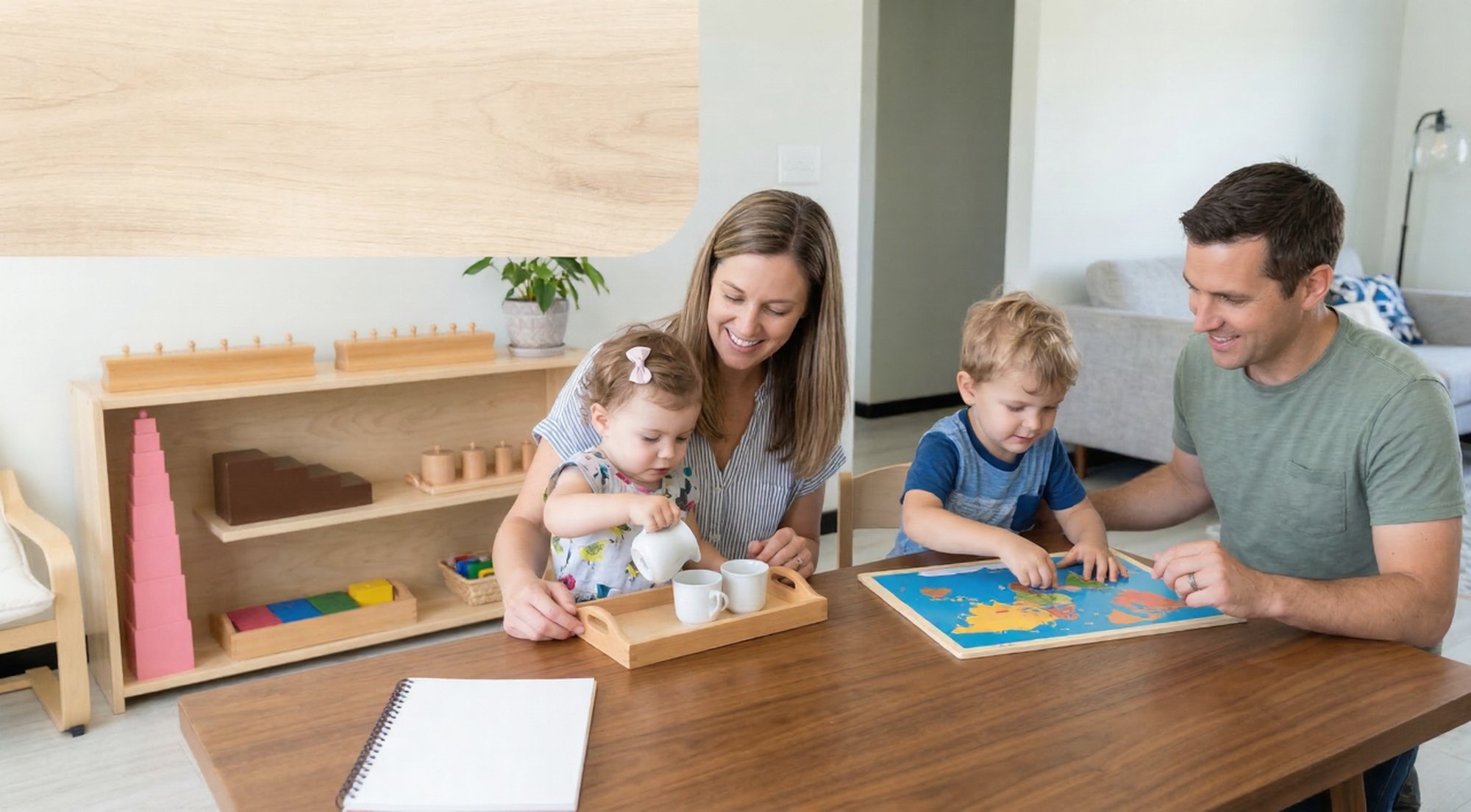
Many parents assume that Montessori education only happens inside a classroom. However, the truth is that the home is the original Montessori environment. Long before a child ever walks into a preschool, the habits, curiosity, and confidence they develop at home shape how they learn for the rest of their lives.
Practising Montessori activities at home does not require expensive equipment or a teaching qualification. It simply requires a shift in perspective — treating your child as a capable and independent person who learns best through doing. Small, everyday moments, from pouring water to sorting laundry, become powerful learning opportunities when a parent understands what to look for.
In this guide, our Montessori-trained teachers share practical activities that any Malaysian parent can introduce at home today. Whether your child attends a Montessori preschool or a conventional school, these activities strengthen the same core skills that every child needs to thrive.
The Montessori Principles Behind Activities at Home
Before diving into specific activities, it helps to understand the principles that make Montessori so effective at home. Knowing the reason behind each activity helps parents apply the approach with confidence rather than simply following a checklist.
Follow the Child
Rather than deciding what your child should learn next, observe what genuinely captures their attention. For example, a child who shows fascination with water pouring is ready for practical life water activities. One who spends time sorting objects by colour, on the other hand, is ready to explore patterns and classification. Following your child’s lead means that learning always feels natural and motivated from within.
Prepare the Environment
Montessori homes organise spaces so that children access their own belongings and materials independently. Low shelves, open baskets, and child-height hooks all signal to a child that this space belongs to them. Furthermore, a well-prepared environment reduces the need for adult intervention because children can find, use, and return everything they need without asking for help.
Step Back and Trust
Montessori parents resist the urge to jump in and help the moment a child struggles. Productive struggle is how children build resilience, concentration, and problem-solving skills. When a child finally completes a difficult task independently, the sense of achievement they feel is far more powerful than any praise from an adult. Indeed, stepping back is one of the most loving things a parent can do.
Practical Life Montessori Activities at Home
Practical life activities form the heart of the Montessori home environment. These are real household tasks that children as young as two years old genuinely enjoy and benefit from enormously.
Pouring and Transferring
Pouring and transferring activities develop fine motor control and concentration simultaneously. Start with dry materials such as rice or lentils before progressing to water. Set up a small tray with two containers and show your child how to pour slowly and carefully. Over time, increase the challenge by using smaller containers or adding a funnel.
Food Preparation
Food preparation gives children genuine agency, ownership, and a sense of real contribution to the family. Even a two-year-old can wash vegetables, tear lettuce leaves, and spread butter on bread. As children grow, they progress to peeling, cutting with a child-safe knife, and measuring ingredients. Moreover, children who help prepare food are far more likely to eat it enthusiastically.
Dressing and Self-Care
Dressing and self-care routines teach children to manage their own bodies and belongings. Offer your child clothes with simple fastenings and allow enough time for them to dress independently without rushing. Similarly, encourage them to brush their own teeth, wash their own hands, and tidy their own shoes. Each small act of independence builds lasting confidence.
Cleaning and Caring for the Home
Children genuinely enjoy sweeping, wiping tables, and watering plants when these tasks truly belong to them. Give your child their own small broom, dustpan, and cloth so that they always have the right tools available. Importantly, resist the temptation to redo their work after they finish, as this sends the message that their effort was not good enough.
Sensorial Montessori Activities at Home
Sensorial activities sharpen a child’s ability to observe, classify, and make sense of the world around them. Furthermore, they lay the cognitive groundwork for later literacy and mathematics.
Sorting and Classifying
Sorting and classifying activities develop logical thinking and attention to detail naturally. Gather a collection of natural objects such as leaves, pebbles, shells, and seeds, and invite your child to sort them by size, colour, or texture. Since there is no single correct answer, children explore freely and develop their own classification systems, which builds creative and flexible thinking.
Sound Matching
Sound matching activities develop phonological awareness, which is essential for reading later on. Fill small identical containers with different materials such as rice, sand, or pebbles and seal them shut. Invite your child to shake them, listen carefully, and match pairs with the same sound. As a result, children sharpen their listening skills in a way that directly supports early literacy development.
Texture Exploration
Texture boards and fabric baskets develop tactile discrimination and sensory vocabulary at the same time. Collect fabric swatches with different textures such as silk, cotton, denim, and velvet, and invite your child to feel each one with their eyes closed. Encourage them to describe what they feel using words like rough, smooth, soft, and bumpy, which builds both sensory awareness and expressive language.
Colour Mixing and Grading
Colour mixing and grading activities build visual discrimination and deep concentration. Use watercolours or food colouring and water to explore how colours blend and change into new ones. In addition, the COZO Montessori approach extends this concept in the classroom through graded colour tablets that children arrange from lightest to darkest, introducing gradation that later appears in formal Montessori mathematics materials.
Language Montessori Activities at Home
Language development flourishes through rich conversation, storytelling, and hands-on exposure to letters and words. Fortunately, many of the most powerful language activities at home cost nothing at all.
Conversation and Storytelling
Rich conversation forms the single most important language activity a parent can offer. Talk to your child constantly about what you see, smell, hear, taste, and feel throughout the day. Narrate your own actions, describe the world around you, and ask open questions that invite more than a yes or no answer. Children who grow up in language-rich homes enter school with significantly larger vocabularies than their peers.
Reading Aloud Every Day
Reading aloud every day builds vocabulary, comprehension, and a genuine love of books that lasts a lifetime. Choose books with rich, detailed illustrations and take time to discuss the pictures as well as the words. Point to words as you read and name letters whenever your child shows interest. Even five minutes of shared reading before bed makes a measurable difference over time.
Sandpaper Letter Tracing
Sandpaper letter tracing gives children a physical experience of letter shapes before they ever attempt to write. Write individual letters on sandpaper cards or trace them onto textured surfaces at home. Show your child how to trace each letter with two fingers while saying its sound aloud. This multi-sensory approach connects sound, shape, and movement in the brain simultaneously, which makes letters far easier to remember.
I Spy and Object Matching
Object-to-picture matching and I Spy games develop phonemic awareness in a playful and engaging way. Collect small household objects and match them to pictures or written labels arranged on a tray. Play I Spy using letter sounds rather than letter names to build the phonics awareness that underpins reading. These simple games require no preparation and children ask to play them again and again.
Mathematics Montessori Activities at Home
Mathematics in the Montessori tradition begins with physical, concrete experiences long before abstract symbols appear. However, parents often discover that these activities look far more like play than formal learning.
Counting Real Objects
Counting real objects builds genuine number sense rather than rote recitation of numbers. Arrange small collections of household objects such as buttons, coins, or blocks and count them together. Importantly, always touch each object as you count so that children connect each number word to a real, physical quantity. This one-to-one correspondence is the foundation of all later mathematics.
Sorting and Patterning
Sorting and patterning activities develop mathematical thinking naturally and joyfully. Use coloured blocks, pegs, or everyday objects to create simple patterns and invite your child to continue them. As children grow, they begin creating their own patterns spontaneously, which demonstrates strong mathematical reasoning and creative thinking working together.
Measurement in Everyday Life
Measurement activities make abstract concepts tangible and immediately relevant to a child’s daily experience. Measure ingredients together when cooking, pour water into containers of different sizes, and compare heights using a ruler or a piece of string. These everyday moments build a deep and intuitive understanding of quantity, comparison, and measurement that no worksheet can replicate.
Number Symbol Matching
Beyond specific activities, the greatest gift a Montessori-inspired approach offers is a shift in how adults relate to children. Indeed, the daily habits and attitudes parents model matter more than any individual activity on any given day.
Slow Down and Include Your Child
When you include your child in cooking, shopping, organising, and caring for the home, you give them meaningful work. Meaningful work builds confidence, purpose, and the deep satisfaction that comes from genuine contribution. Slowing down to involve your child takes more time in the short term, but the independence it builds saves enormous effort later on.
Speak with Respect
Speak to your child with the same respect you would offer another adult. Explain your reasoning, invite their opinion, and acknowledge their feelings without dismissing them. Children who experience respectful communication learn to communicate respectfully in return, which is one of the most valuable social skills they will ever develop.
Trust Their Capability
Most children are capable of far more independence than adults typically allow them. Resist the urge to take over when things get messy, slow, or imperfect. Imperfection is precisely where learning lives, and a child who practises a skill repeatedly until they master it gains far more than one whose parent steps in to finish the task for them.
Create Order and Beauty
A tidy, accessible, and aesthetically pleasing space invites concentration and care in young children. Even small gestures like placing a flower on a low shelf or keeping toys organised on open trays send a powerful message: this environment respects you and expects you to respect it in return. Over time, children internalise this order and begin to maintain it themselves.
Conclusion
Bringing Montessori activities at home into your daily routine is one of the most effective ways to support your child’s development between preschool sessions. Simple, consistent activities rooted in real life build the independence, concentration, and love of learning that last a lifetime.
Want to deepen your understanding of how Montessori works? Our Montessori-trained teachers at COZO in Cheras and Bukit Jalil welcome parent conversations, campus tours, and workshops. Explore our campus today and discover how our approach supports your child both at school and at home.
