
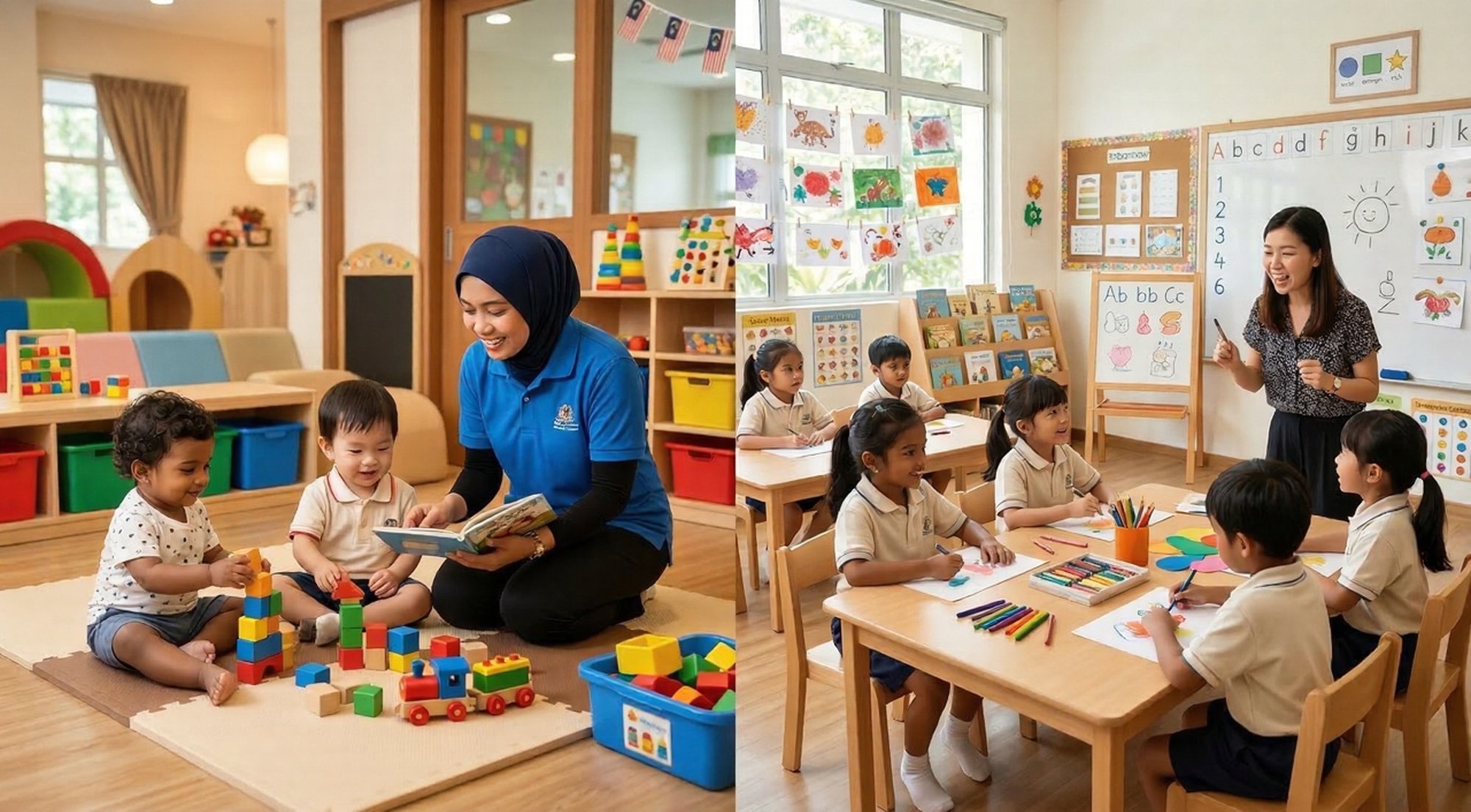
Many Malaysian parents use the words childcare and kindergarten interchangeably, but these two options are meaningfully different in ways that matter greatly for your child. Understanding the distinction between childcare and kindergarten helps families choose the right programme at the right time, rather than defaulting to whichever option happens to be closest or most familiar.
Both childcare and kindergarten play important roles in early childhood development, and for many families the two work best together rather than as alternatives. However, each serves a different primary purpose and suits a different set of family circumstances. Families searching for quality childcare and kindergarten in Malaysia that combines both functions under one roof will find this guide especially useful.
In this guide we break down exactly what childcare and kindergarten mean in the Malaysian context, how they differ across structure, age range, curriculum, and cost, and how to decide which one your child needs right now.
What Childcare and Kindergarten Actually Mean in Malaysia
Before comparing the two options, it helps to establish clear definitions that reflect how these terms are used in Malaysia specifically.
What Is Childcare?
Childcare in Malaysia refers to supervised care for children from infancy through to primary school age, provided during hours when parents are unavailable. The primary focus of childcare is the safety, nurturing, and general wellbeing of children rather than formal educational delivery. Quality childcare centres offer structured daily routines, nutritious meals, rest periods, and age-appropriate play and stimulation. Many also integrate early learning activities, but the care function remains central to what they do.
What Is Kindergarten?
Kindergarten in Malaysia refers specifically to a structured educational programme for children aged four to six that prepares them for entry into Year 1 of primary school. Sessions typically run for three to four hours per day and follow a curriculum aligned with school readiness goals. The Ministry of Education oversees the national kindergarten curriculum, and most kindergartens follow this framework or an approved alternative such as Montessori. Unlike childcare, kindergarten does not primarily serve a care function and generally does not provide full-day supervision for working parents.
Where They Overlap
In practice, many modern centres in Malaysia combine both functions, offering full-day programmes that deliver kindergarten education alongside childcare. These combined programmes are often the most practical solution for working families who want educational quality without sacrificing the convenience of full-day coverage.
Key Differences Between Childcare and Kindergarten
Childcare and kindergarten differ across several practical dimensions that directly shape your child’s daily experience and your family logistics. Understanding these differences side by side helps parents make the most informed decision possible.
Operating Hours
Operating hours represent the most immediately practical difference between the two. Childcare centres typically operate from around seven in the morning until six or seven in the evening, accommodating full working days and commutes. Kindergartens, in contrast, usually run morning or afternoon sessions of three to four hours, which suits families where a parent is home during the day but not those where both parents work full time.
Age Range
Age range also differs significantly between the two settings. Childcare centres accept children from as young as two months old, making them the only viable option for families with infants and very young toddlers. Kindergartens generally cater to children aged four to six, and most require children to be toilet-trained and able to manage basic self-care before entry.
Curriculum Structure
Curriculum structure differs meaningfully as well. Childcare programmes focus on care routines, play-based stimulation, and social development, with early learning woven naturally into the day rather than delivered through formal lessons. Kindergarten programmes, on the other hand, follow a more structured curriculum with defined learning objectives in literacy, numeracy, science awareness, and social studies.
Class Sizes and Ratios
Class sizes and ratios also typically differ between the two settings. Childcare centres maintain lower ratios for younger children, particularly infants and toddlers, to meet both regulatory requirements and the intensive care needs of very young children. Kindergartens generally operate with slightly higher ratios reflecting the more group-oriented nature of educational delivery for older children.
The Benefits of Quality Childcare
Quality childcare delivers developmental benefits that extend far beyond basic supervision. Research consistently shows that children who attend high-quality childcare from an early age demonstrate measurably stronger social development, language growth, and emotional resilience compared to children who remain at home without structured care.
Early Socialisation
Early socialisation is one of the most significant benefits of childcare. Young children learn to share, take turns, navigate small conflicts, and build their first friendships through daily interaction with peers in a safe and supervised environment. These foundational social skills lay the groundwork for the cooperative learning that both kindergarten and primary school require.
Language Development
Language development accelerates in quality childcare environments. Skilled caregivers engage children constantly in rich conversation, narrate daily routines, read aloud, and sing together throughout the day. Children raised in language-rich environments enter kindergarten with measurably larger vocabularies and stronger communication foundations than peers who have spent less time in such settings.
Emotional Security
Emotional security is perhaps the most profound benefit of excellent childcare. Children who develop trusting and consistent relationships with caring adults outside the home build the resilience and confidence that learning in any setting requires. Furthermore, quality childcare supports the wellbeing of the whole family by giving working parents the peace of mind to focus fully on their professional responsibilities.
The Benefits of Quality Kindergarten
Kindergarten delivers specific educational benefits that directly prepare children for the structured learning environment of Malaysian primary school. Research consistently shows that children who attend quality kindergarten programmes outperform their peers on academic and social measures at the point of primary school entry.
Academic Preparation
Academic preparation is the most obvious benefit of kindergarten. Children develop early literacy through phonological awareness, letter recognition, and pre-reading activities. They build numeracy foundations through counting, number recognition, patterning, and basic mathematical reasoning. These skills give children a genuine head start that research shows tends to persist well into secondary school.
School Readiness Beyond Academics
School readiness encompasses much more than academic knowledge, however. Kindergarten teaches children to sit within a group, follow teacher instructions, manage transitions between activities, and regulate their own behaviour during learning time. These skills prove just as essential as academic knowledge when children start Year 1, and primary school teachers consistently report that children who lack them struggle to settle regardless of their intellectual ability.
Social and Emotional Learning
Social and emotional learning deepens through the cooperative environments that quality kindergartens create. Children learn to work together, resolve disagreements respectfully, and empathise with peers — competencies that predict long-term wellbeing and success as powerfully as academic ability. Indeed, a child who enters primary school knowing how to build friendships and handle conflict holds a lasting advantage over the years ahead.
When Childcare and Kindergarten Work Best Together
For many Malaysian families, the question is not childcare or kindergarten but rather how to combine both effectively. Combined programmes have become increasingly popular across KL and the Klang Valley precisely because they solve the working parent dilemma without compromising on educational quality.
How Combined Programmes Work
A combined childcare and kindergarten centre delivers a structured kindergarten curriculum during the morning hours, then transitions into enriched childcare during the afternoon. Children therefore receive the educational benefits of kindergarten alongside the care and supervision that working families need throughout the full working day. Beyond convenience, the combined model supports emotional security because children maintain consistent relationships with the same teachers and peers from morning to afternoon.
What to Look for in a Combined Programme
A genuine combined programme maintains the same educational commitment across the full day rather than switching off after the morning session ends. Lower-quality versions simply offer supervised play in the afternoon, which represents a missed opportunity for continued growth. When evaluating any combined centre, ask specifically what structured activities happen after lunch and how teachers sustain engagement and learning energy across the full day.
How to Decide What Your Child Needs Right Now
Several important factors shape the right childcare and kindergarten decision for each individual family. No single answer suits everyone, which is why understanding these factors helps parents tailor their decision to their own circumstances.
Your Child’s Current Age
Your child’s current age matters most immediately. Children under four years old need childcare since most kindergartens do not accept children below this age. Once your child approaches four or five, a quality kindergarten or combined programme becomes the most educationally appropriate choice and the natural next step in their development.
Your Working Hours
Your working hours determine how much care coverage you need each day. Households where both parents work full time typically need a combined programme or a childcare centre that also delivers structured kindergarten learning. Parents with more flexible schedules, on the other hand, may find that a dedicated kindergarten session meets their child’s educational needs while a part-time care arrangement covers the remaining hours.
Your Child’s Personality and Readiness
Your child’s personality and developmental readiness also influence the decision significantly. Some children thrive in the more structured environment of a formal kindergarten from age four, while others benefit from another year of play-based childcare before transitioning into a more educational setting. Trust your knowledge of your own child and, when in doubt, ask a trusted early childhood professional for guidance.
Your Budget
Budget plays a practical role as well. Full-day combined programmes tend to cost more than half-day kindergarten sessions, but they also deliver more value in terms of total hours of quality care and education. Consider the full cost of your childcare and education arrangements together rather than evaluating each option in isolation, since a combined programme often works out more affordable than two separate arrangements.
Conclusion
Both childcare and kindergarten play essential roles in the early development of Malaysian children, and the best families choose not one or the other but the right combination of both. Understanding exactly what each option offers, when each one suits best, and how they complement each other gives parents the clarity they need to make truly confident decisions.
At COZO, our flexible child care programmes in Cheras and Bukit Jalil combine full-day childcare with authentic Montessori kindergarten education. Find out more today and discover how our blended approach supports your child from their earliest years through to confident primary school readiness.
